

Don’t Let Your Smile’s Foundation Disappear
Bone Grafting Returns What You’ve Lost
If you have one or more missing teeth or have had a tooth extracted, it’s important to restore proper bone levels in your jaw. As the foundation of your smile, your bone plays a vital role in your oral health and function. It supports your teeth and helps preserve your facial structure, but it needs the stimulation of tooth roots to remain dense and strong. When teeth are extracted or lost, the jawbone no longer receives stimulation and will resorb, shrink and disappear.
Bone loss can lead to shifting and loosening of remaining teeth, loss of lip and cheek support, and jaw joint problems. Without enough bone support, you may not be able to replace your missing teeth with dentures or dental implants. To regain your facial foundation and help ensure these functional and esthetic consequences do not occur or worsen, our periodontist and dental team at Garazi Periodontics & Dental Implants provide bone grafting in Miami, FL. This procedure restores the jawbone volume or density that has been lost due to missing teeth to improve your oral health and function.
Why See A Periodontist For Treatment?
A periodontist is a recognized dental specialist who has spent additional years of training in treatments related to soft tissues and bone. Along with extensive experience in complex bone grafting procedures, a periodontist also has the trained eye to optimize soft tissue esthetics. Seeking bone grafting treatment from a periodontist like Dr. Garazi can have lasting benefits for your health, function, and smile aesthetics. Additionally, as an expert in dental implants, our periodontist can not only help you qualify for dental implants but also predictably replace all your missing teeth with this secure, lasting, and lifelike solution!

The Process For Restoring Lost Bone
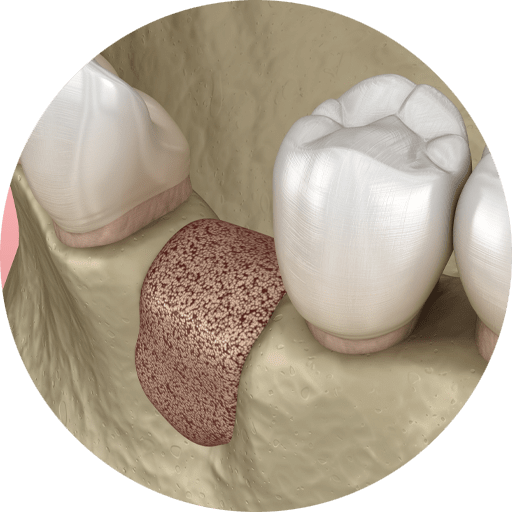
Bone grafting is a surgical procedure that involves placing dental bone graft material in areas where the bone has resorbed or a tooth has been extracted. We offer bone grafting in Miami, FL, with the purpose of restoring the proper density, height, and width of the bone in the jaw in preparation for dental implants. In general, bone grafting may involve one or more of the following procedures:
Socket Preservation
Socket preservation is a bone grafting procedure our periodontist completes at the time of tooth extraction. This involves packing bone graft material into the empty tooth socket. Socket preservation slows the resorption process where the tooth is missing. It can also help preserve the health of the bone until a dental implant can be placed.
Ridge Augmentation
Ridge augmentation refers to a bone grafting procedure that restores the natural height and width of the jawbone for part or the entirety of a jaw ridge. It is essential to place dental implants properly, in order for the restorations to lead to better long-term results and to restore healthy bone levels to your jaw.
Sinus Lifts
When a bone in the premolar or molar areas of the upper jaw has lost density or volume, a sinus lift in Miami, FL, may be required in order to accommodate dental implants. Gently lifting the sinus cavity, bone grafting material can be placed to restore proper bone height.
The Benefits Of Bone Grafting
Bone grafting seems like just a functional treatment meant to improve your oral health, but this treatment also has more widespread benefits. Tooth and bone loss can lead to numerous problems that affect your ability to eat, your oral and physical health, as well as your personal well-being. By restoring bone levels in your jaw, our Miami, FL team can treat infection and disease, replace missing teeth with restorations like dental bridges and dentures, as well as prepare you for dental implants. Having a smile restored to proper function and esthetics can significantly improve your confidence, health, and quality of life!


